
Affected users only
Publish guidance by application, service, department, group, office, or domain so unaffected teams are not trained to ignore alerts.
Communicate / Status Alert
Status Alert gives operations teams a controlled way to author, target, publish, and audit incident guidance inside the browser workflow instead of relying only on email, chat, or ticket queues.
Command center
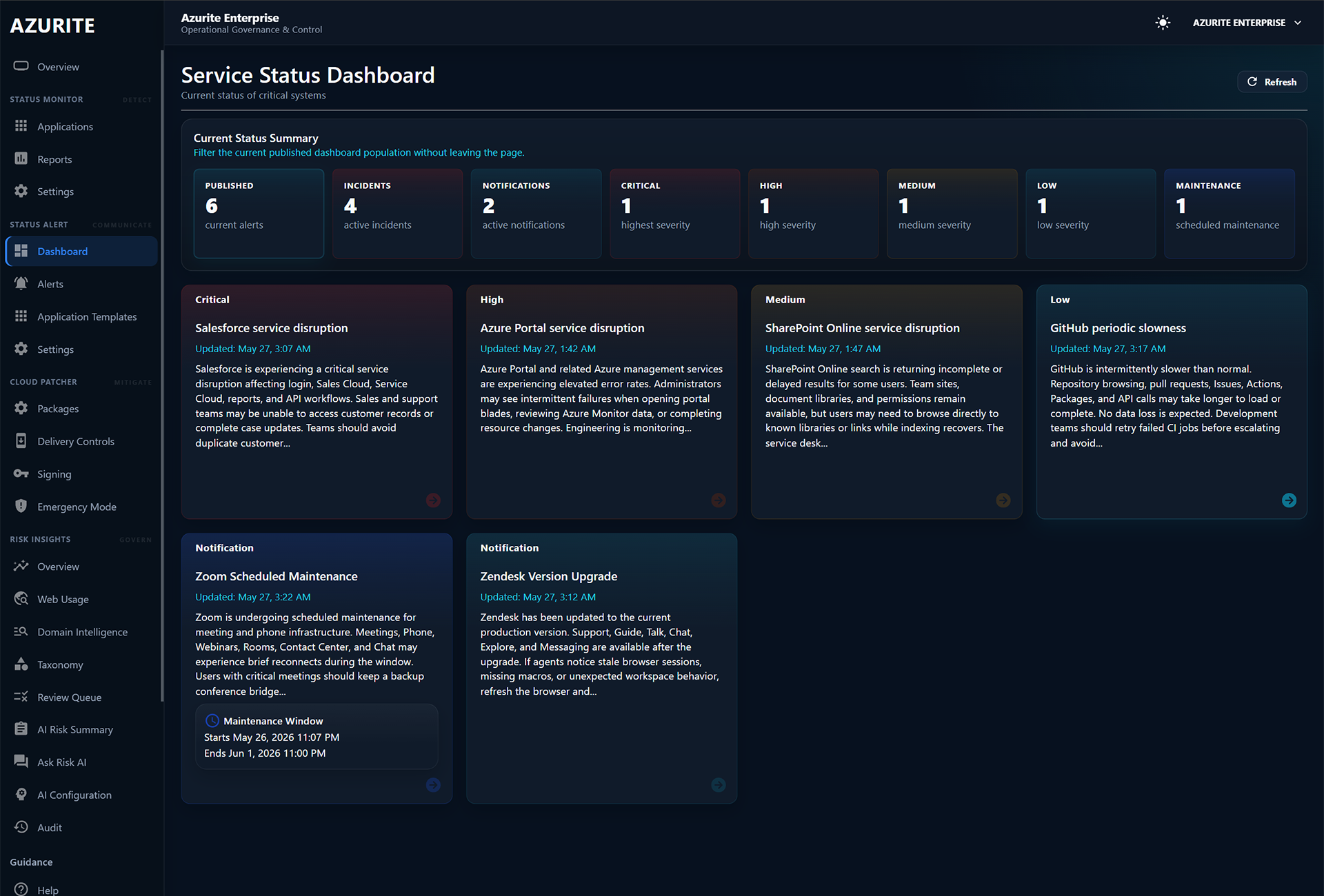
Operational communication
Status Alert keeps communication accountable when cloud, vendor, identity, or internal application disruption affects real work.
Publish guidance by application, service, department, group, office, or domain so unaffected teams are not trained to ignore alerts.
Use banners, browser notifications, both, or forced redirect behavior when a workflow must be stopped or redirected.
Status Monitor can create draft, review, or auto-published alerts when sustained checks cross operational thresholds.
Lifecycle state, schedule windows, affected services, and resolution history become reviewable operational evidence.
Module handoff
Status Alert is independently valuable, but it becomes sharper when Status Monitor provides the signal and Risk Insights preserves the governance context.
Status Monitor detects sustained failure, latency, DNS, authentication, or endpoint health signals.
Configured handoff mode determines whether the alert starts as draft, review, or published guidance.
The browser extension delivers targeted instructions directly in the affected workflow.
Operational teams retain communication history for audit, post-incident review, and executive reporting.
Azurite Enterprise
Bring detection, communication, governed remediation, and cloud risk intelligence into one enterprise operating model.